Effective erosion control and slope stabilization start with matching materials to site-specific conditions. A steep grade shedding stormwater at a construction site behaves differently than a gentle swale beside an access road or a pipeline corridor crossing several soil types. Slope severity and runoff velocity drive that initial product decision, while service life and vegetation goals determine whether a site needs temporary surface protection or permanent reinforcement. As grading progresses and final slopes take shape, those material requirements often change again.
What Drives Slope Erosion and Instability Across Different Site Conditions?
Rainfall is a major driver of slope erosion, but grading work, stormwater discharge, soil conditions, and slope geometry also play a role. Recognizing what drives erosion on your site is the first step toward selecting the right erosion control solution.
Rain dislodges exposed soil, and surface runoff carries the loosened particles downslope. Steeper gradients increase the energy behind that runoff. Removing vegetation strips away the root systems that would otherwise hold the soil in place. Soil type and slope geometry further influence how readily exposed material moves once these forces are present.
Grading work changes drainage paths across a site, and trenching or clearing exposes more soil to these forces as construction progresses. Water that infiltrates the ground can also raise pore-water pressure within the soil mass, reducing its resistance to movement and increasing the risk of deeper slope failure.
Qualifying construction stormwater discharge requires Clean Water Act permit coverage under the National Pollutant Discharge Elimination System. Even projects that individually disturb less than an acre can require coverage as part of a larger common plan of development. The U.S. Environmental Protection Agency (EPA) or an authorized state program provides the applicable permit and oversees ongoing compliance, depending on your project’s location.
Sites covered under the EPA’s Construction General Permit must develop a Stormwater Pollution Prevention Plan before submitting a Notice of Intent, documenting erosion control solutions, sediment measures, pollution prevention, inspections, maintenance, and corrective actions. If left unaddressed, slope instability can lead to property damage, environmental contamination from sediment-laden runoff, and safety hazards for crews and nearby structures. Regulations are subject to change, and operators should verify current permit requirements.
Which Erosion Control Methods and Materials Fit Your Site?
The right erosion control method depends on slope conditions and runoff forces. Effective slope stabilization methods may combine surface protection with structural reinforcement or drainage.
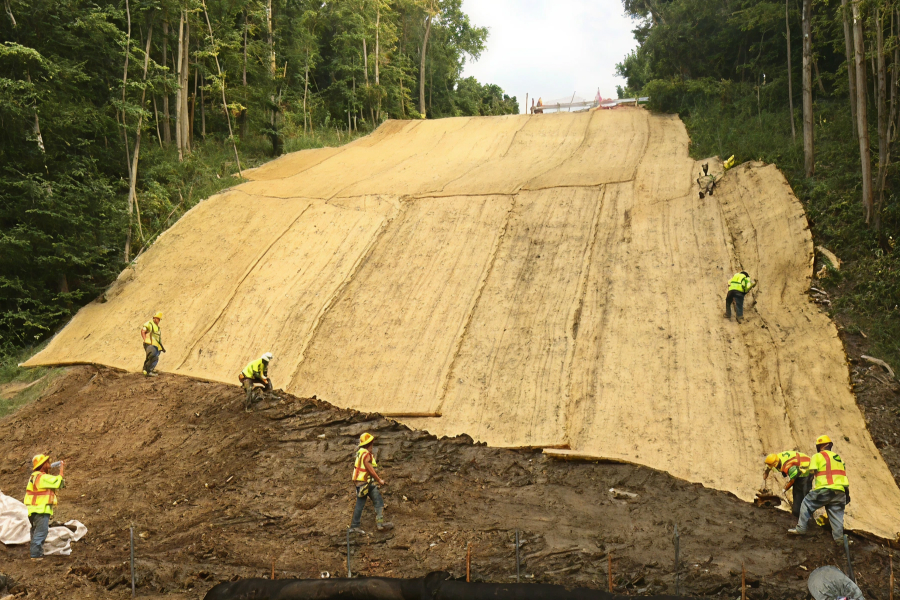
Rolled erosion-control blankets:Erosion control blankets protect soil as vegetation establishes, and coconut-fiber options can extend that coverage. Short-term blankets suit slopes of 2H:1V or flatter, but can vary by manufacturer or product, so check the specifications up front. Specified extended-term products may support steeper applications.
Permanent turf reinforcement mats:Permanent turf reinforcement mats (TRMs) reinforce vegetation exposed to ongoing hydraulic forces. Product ratings indicate whether a given mat is suitable for 1H:1V slopes, streambanks, shorelines, or high-flow channels.
Hydraulic erosion-control products: Hydraulic application distributes fiber mulch across large or hard-to-access slopes, and suitable tackifiers can bind the applied fibers and mulch when needed. Engineered fiber matrices may offer greater erosion resistance than basic mulch in suitable applications.
Surface mulch: Straw or wood fiber mulch provides temporary protection on mild slopes, and compost can be used in select applications. Netting and crimping help retain loose material, and tackifiers offer another application-specific option.
Geogrids and hard armor: Geogrids and other engineered products can reinforce slopes or embankments and may support retaining wall systems. Aggregate-filled gabions or Reno mattresses are well-suited to high-velocity applications when project-specific engineering supports their use. Bedrock carries a multitude of engineered products for many applications to best fit your site’s needs.
Site-Specific Erosion Control Strategies for High-Risk Project Types
Effective soil erosion prevention techniques vary by project type, as each site presents its own mix of grading sequences, soil exposure, and runoff patterns.
Project Type
Site Conditions
Stabilization Approach
Construction sites
Sequential grading exposes new soil and redirects runoff.
Install downgradient sediment controls before disturbance, then add remaining controls before later phases. Pair surface protection with perimeter controls.
Data centers
Pads, access routes, and drainage paths change as infrastructure comes online.
Use movable controls in active zones, then install permanent measures at the final grade.
Pipeline corridors
Rights-of-way cross varying soils and slope conditions.
Apply regional seed mixes after backfilling, then protect suitable segments with rolled products.
Solar farms
Panel rows may concentrate runoff or create wet areas along drip lines.
Establish low-growing perennial cover, then add drainage measures where vegetation can’t handle runoff on its own.
How to Protect Your Site Through Freeze-Thaw Cycles and Wet-Weather Conditions
Reliable slope erosion control systems must be in place before freezing weather limits your installation window. Stabilize exposed soil while conditions still allow proper anchoring and soil contact. Keeping drainage paths open and accessible allows snowmelt and rainfall to move through the site rather than pooling against controls or cutting new channels.
Inspect installed controls before seasonal runoff increases, checking for gaps that could allow water to bypass the protection altogether. Appropriately rated blankets protect bare or mulched soil once it’s prepared, but correct anchoring and consistent soil contact are what prevent runoff from working its way beneath them.
Pre-thaw inspections should identify lifting, displacement, or blocked outlets before spring runoff arrives. When saturated ground won’t support proper compaction, pausing any soil-disturbing work until conditions improve protects both the installation and the surrounding site.
Bonded fiber matrices can support suitable sheet-flow slopes during wet weather, and high-performance TRMs reinforce appropriately rated high-flow channels under similar conditions. Sites covered under the EPA’s Construction General Permit must begin stabilization whenever work will pause for 14 or more calendar days, regardless of the season.
FAQs About Erosion Control and Slope Stabilization
These questions come up often when comparing erosion-control and slope-stabilization approaches.
What is the difference between erosion control and slope stabilization?
Erosion control addresses surface soil loss, while slope stabilization addresses movement within the soil mass itself. Surface measures like blankets and mulch help stop soil from detaching and being washed away, but they cannot correct deeper structural movement. Slopes affected by that kind of instability need structural reinforcement or drainage support instead. Many projects require both approaches to work together.
When should you use erosion control blankets vs. turf reinforcement mats?
Erosion control blankets suit projects that need temporary surface protection. TRMs are best for projects that need permanent vegetated reinforcement against continuing hydraulic forces. Slope steepness offers a starting point for that decision, but rated performance and expected flow conditions provide a stronger basis for selection. Confirm the material composition and required service life before choosing.
How do you prevent erosion on steep slopes or construction sites?
Preventing erosion on steep slopes or active construction sites depends on slope ratio, soil erodibility, expected runoff, and the current phase of grading. High-performance TRMs address rated surface erosion or hydraulic stress, geogrids can reinforce soil masses, and hard armor or engineered products protect areas exposed to substantial hydraulic forces. Drainage-related weakness or deeper instability calls for site-specific engineering and required stormwater controls need to be in place before each new grading phase begins.
What is the best erosion control method for winter or freeze-thaw conditions?
The best erosion control method for winter or freeze-thaw conditions depends on your site, but erosion control blankets provide immediate surface protection. Bonded fiber matrices can cover prepared slopes when application conditions allow it. Slope geometry and expected snowmelt runoff determine which product is appropriate, and anchoring and soil contact need inspection before thawing begins to ensure displaced material is repaired promptly.
Partner With Bedrock Environmental
Working with an experienced partner gives you peace of mind that your site will be protected throughout various conditions. Bedrock Environmental matches erosion-control materials to your specific site conditions and offers proactive technical guidance through a single responsive point of contact, rather than juggling multiple vendors. Our product range includes hard-to-find materials for planned or urgent needs, delivered nationwide to keep your schedule on track.
Contact us today. Take the first step toward implementing effective erosion control and slope stabilization solutions.
Erosion Control and Slope Stabilization: Methods, Materials, and Site-Specific Strategies
Effective erosion control and slope stabilization start with matching materials to site-specific conditions. A steep grade shedding stormwater at a construction site behaves differently...