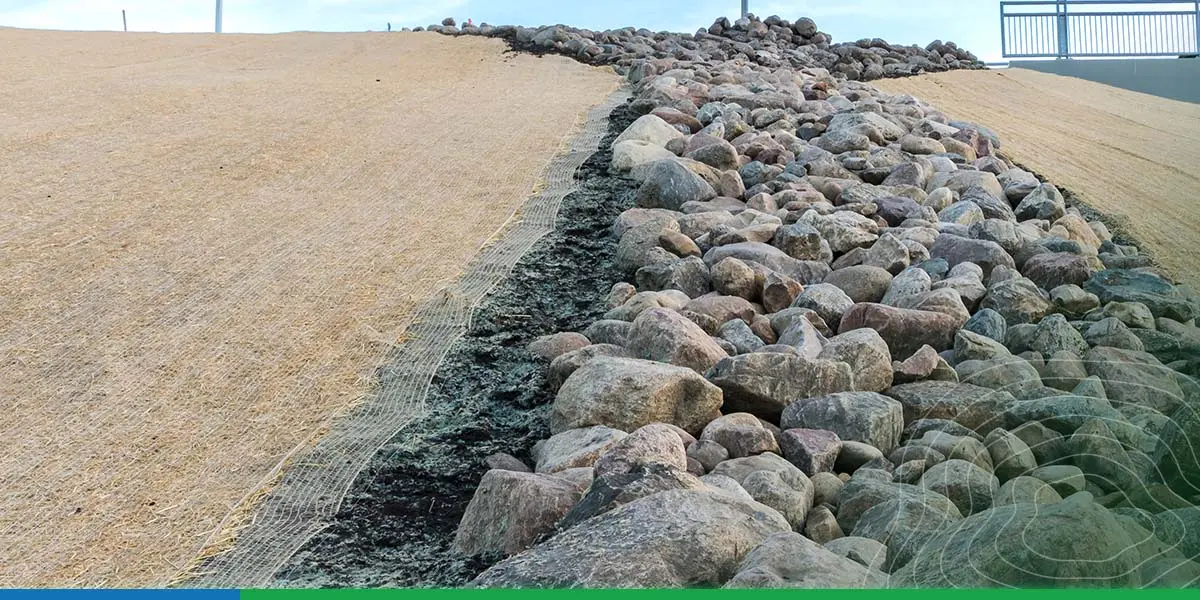
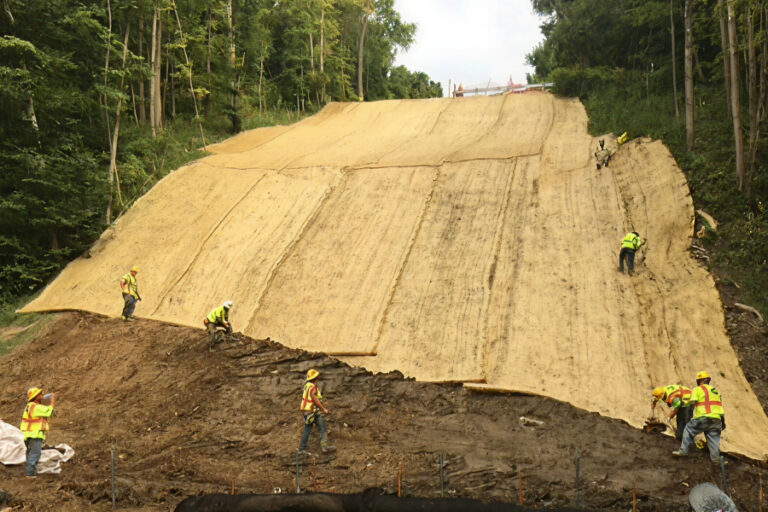
Both erosion control blankets (ECBs) and turf reinforcement mats (TRMs) are rolled erosion control products (RECPs). These products perform under different conditions, and matching the right one to your job comes down to slope steepness, water flow force, and how quickly vegetation can establish.
What Is an Erosion Control Blanket?
An erosion control blanket is a temporary, biodegradable RECP made from natural fibers such as straw, coir, or excelsior, bound together with photodegradable or biodegradable netting. It protects bare soil right after seeding by creating the moisture retention and reduced raindrop impact needed for seed germination.
As vegetation establishes, an ECB hands off stabilization duty to the root system and breaks down on its own, so no removal is required. Its lifespan matches the establishment window: short-term straw ECB options are rated 90 days to 12 months, while coir or straw-coir blends can extend coverage to 24-36 months for longer establishment windows.
Most rolled ECBs hold steady at or below 2.0 to 2.5 lbs/ft² of water flow force, which covers open slopes and post-grading sites well.
What Is a Turf Reinforcement Mat?
A turf reinforcement mat is a permanent, non-degradable RECP built from UV-stabilized polypropylene fibers, engineered to support vegetation well beyond the point where a biodegradable product would break down. Its three-dimensional matrix creates void space for root penetration and soil infill, so the system reinforces itself as vegetation fills in around it.
Because TRMs do not biodegrade, they stay effective on sites where erosive forces continue well after construction wraps up. Standard TRMs handle water flow force up to 13 lbs/ft² once vegetated, which clears most channel and streambank applications. High-performance TRMs for extreme conditions have a higher capacity rating for high-flow channels and steep faces.
Erosion Control Blanket vs. Turf Reinforcement Mat Comparison Table
The table below compares temporary vs. permanent erosion control options across the variables that drive product selection.
Variable
Erosion Control Blanket
Turf Reinforcement Mat
Material
Natural fibers with biodegradable or photodegradable netting
UV-stabilized polypropylene matrix, sometimes with degradable infill
Biodegradability
Yes, breaks down as vegetation establishes
No, permanent by design
Lifespan
Short-term: 90 days to 12 months; Longer-term: 24-36 months
Permanent
Slope range (horizontal to vertical)
4:1 to 1.5:1
1:1
Permissible shear stress
Approximately 2.0 to 2.5 lbs/ft²
Up to 13 lbs/ft² standard, higher for HPTRMs
Primary applications
Open slopes, post-grading seeding, DOT roadside
High-flow channels, steep slopes, streambanks
Erosion Control Technology Council (ECTC) category
1 to 4
5A to 5F
When Should You Use an Erosion Control Blanket?
An erosion control blanket is the right call when a site’s erosive forces fall within its performance range, and vegetation can establish within the blanket’s rated lifespan. Review these key factors:
Open slope and grading projects: Post-construction grading, highway and DOT roadside work, solar site ground cover, and pipeline corridor reclamation are temporary stabilization problems suited to an ECB.
Slope and shear stress thresholds: The site should fall between 4:1 and 1.5:1 (horizontal to vertical) with design storm shear stress at or below 2.0 to 2.5 lbs/ft².
Seed mix pairing: Matching the blanket to the right seeding and seed mix for the region strengthens vegetation establishment, with straw or excelsior suited to 90-day to 12-month cover and specialty seed mixes suited to longer windows.
Cost efficiency: When ECB conditions are met, an ECB can deliver the performance the site needs at a lower cost per square foot than a TRM. The cost savings are by design, since ECBs are made from natural agricultural fibers, which can keep material costs lower than the engineered synthetic matrix of a TRM.
When Should You Use a Turf Reinforcement Mat?
Knowing when to use turf reinforcement mats comes down to these site conditions:
Steep slope applications: Turf reinforcement mats are the specification-correct product on 1:1 grades, as steeper slopes concentrate runoff and generate higher shear stress than an ECB is rated to resist.
High shear stress sites: Standard TRMs handle water flow force up to 13 lbs/ft², and high-performance mats extend coverage further for extreme hydraulic conditions.
Channels and permanent flow: Vegetated channels and streambanks carry ongoing water flows that need structural reinforcement beyond what vegetation alone can deliver, which is why certain guidance highlights TRM for these applications.
Common Mistakes When Choosing ECB vs. TRM
Most ECB versus TRM selection errors stem from treating both products as interchangeable RECPs when they serve entirely different performance envelopes. Here are some common mistakes:
Installing an ECB in a channel or concentrated flow area: Channels generate shear stress that exceeds ECB ratings, so TRM can often be the solution for these kinds of applications, depending on shear stress, flow conditions, and vegetation limits.
Specifying an ECB beyond its rated slope: Steeper slopes concentrate runoff and generate higher shear stress than open grades, so any application on a 1:1 grade typically calls for TRM, with the exact threshold depending on TRM type.
Mismatching product lifespan to the establishment timeline: On sites with compacted or nutrient-depleted soils where vegetation may need 18 months or more to establish, a short-term ECB runs out of protection before the slope is stable.
Choosing by price rather than performance category: ECBs and TRMs sit in the same product family, but the governing ECTC category determines which product the site actually requires.
FAQs
Here are some common questions when it comes to specifying the right erosion control materials.
Erosion control blankets offer a temporary, biodegradable solution that can protect soil until the vegetation establishes before breaking down. Turf reinforcement mats are a permanent and synthetic option, reinforcing vegetation against hydraulic stress for the project’s life.
TRMs are made from UV-stabilized polypropylene, which does not degrade. The mat reinforces root systems permanently. That permanence is the design intent for sites where hydraulic forces continue after construction.
Whether you can use an erosion control blanket on a steep slope depends on the ratio. ECBs are rated for slopes from 4:1 to 1.5:1, and beyond roughly 2:1, a blanket falls outside its rated range. On 1:1 grades, TRM is usually the specification-correct choice.
Dense, established vegetation offers the strongest long-term protection, but it needs support to get there. An ECB paired with the right seed mix handles temporary stabilization, while a TRM extends protection to steep slopes and channels.
Source Your ECBs and TRMs From Bedrock Environmental
Bedrock Environmental is your one-stop shop for erosion control products. We pair you with a single point of contact backed by a full technical team, giving you fast answers and full access to our comprehensive catalog of erosion control, geosynthetics, and amendments. Our team reviews site conditions early and will track down hard-to-source materials, even when they are not on our regular shelf, so recommendations fit the real demands of the job. Contact our team to talk through your site conditions and find the right product today.
Erosion Control Blanket vs. Turf Reinforcement Mat: Which One Does Your Site Need?
Both erosion control blankets (ECBs) and turf reinforcement mats (TRMs) are rolled erosion control products (RECPs). These products perform under different conditions, and matching...
Erosion Control and Slope Stabilization: Methods, Materials, and Site-Specific Strategies
Effective erosion control and slope stabilization start with matching materials to site-specific conditions. A steep grade shedding stormwater at a construction site behaves differently...